
At a time when humanitarian action is being reshaped by geopolitical shifts, climate emergencies, growing inequalities, and evolving global health priorities, the 4th edition of Doctors Without Borders/Médecins Sans Frontières (MSF) South Asia’s Health and Humanity Summit convened in Colombo, Sri Lanka, under the theme ‘Envisioning the Future of Humanitarianism’. Bringing together policymakers, public health experts, humanitarian practitioners, academics, civil society leaders, and advocates from across South Asia and beyond, the Summit created a platform to explore how humanitarian action can remain principled, equitable, and effective in an increasingly multipolar world.
Building on the momentum of previous editions across India, Sri Lanka and Nepal, the 2026 Summit shifted the conversation from responding to today’s humanitarian challenges toward shaping the systems that will define tomorrow. As global dynamics evolve and new actors assume greater influence in health financing, governance, and crisis response, the Summit examined how humanitarian principles can adapt without compromising their core values of neutrality, independence, and impartiality.
Setting the tone for the day’s discussions, event’s spotlight speakers from South Asia Dr Roshni Changalath, Imtiaz Wadud and Dr Karan Kamble, who have served in multiple country programs, brought to life the realities faced by aid workers and patients in some of the most challenging contexts of the world. Drawing on their own lived experiences from the frontlines, MSF’s International Mobile Staff(IMS) shared the difficult truths about conflict and crisis through powerful stories of devastation and resilience.
Following the spotlight address, the rest of the day’s discussions centred on three interconnected themes: Envisioning the Humanitarian and Health Architecture, Envisioning the Future of Women’s Leadership in Global Health and Humanitarianism, and Envisioning the Future of Healthcare Sovereignty and Access. Together, these conversations examined new models of humanitarian governance, equitable leadership, regional cooperation, health sovereignty, and access to medicines, while exploring how communities, governments, humanitarian organizations, and emerging global partners can collectively shape a more resilient humanitarian future.
Executive Director of MSF South Asia, Parthesarathy Rajendran, opened the Summit by calling for a renewed vision of humanitarian action grounded in equity, solidarity, and shared responsibility;
“Humanitarian action stands at a defining moment. Around the world, we are witnessing profound changes in the way crises unfold, how they are financed, and who shapes the responses. Yet amidst these transitions, one principle must remain unwavering: every person has the right to timely, quality healthcare, regardless of politics, geography, or circumstance. This year’s Health and Humanity Summit is an opportunity to move beyond diagnosing the challenges before us and instead collectively imagine the humanitarian architecture we want for the future, one that is more inclusive, locally led, gender-responsive, and rooted in genuine global solidarity. By bringing together diverse voices from across South Asia and beyond, we continue to foster meaningful dialogue that strengthens humanitarian action for the generations to come.”
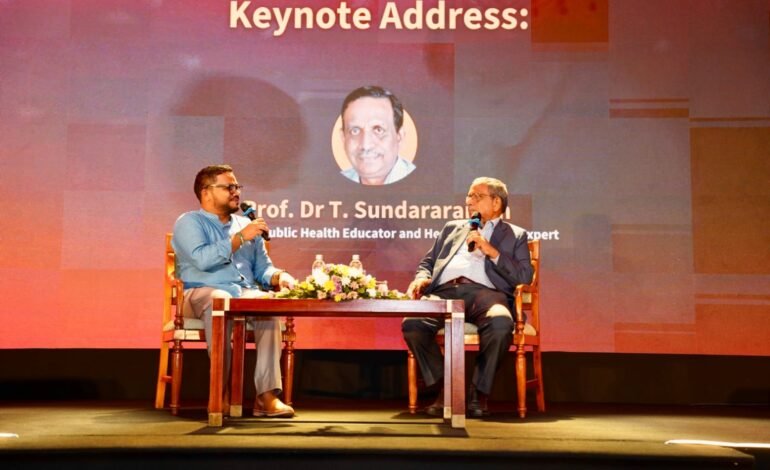
The Summit featured distinguished speakers including Prof. Dr. T. Sundararaman, physician and global health systems expert, who delivered the keynote address, alongside Dr. Rajesh Sambhajirao Pandav, WHO Representative to Sri Lanka; Prof. Imtiaz Hussein, Founder of the Global Studies & Governance Department at the Independent University, Bangladesh; Nabeela Iqbal, founder of the Sisterhood Initiative; Prakriti Dhakal, Under Secretary to the Prime Minister of Nepal; and other regional and global experts.
The Summit’s first panel, Envisioning the Humanitarian and Health Architecture, examined how humanitarian financing and governance are evolving amid changing geopolitical realities. Moderated by Dr. Ravi Ranna-Eliya, Executive Director of the Institute of Health Policy, Sri Lanka, the discussion explored how emerging Global South economies can play a greater role in humanitarian leadership while advancing more representative, equitable, and sustainable models of financing and decision-making.
The second panel, Envisioning the Future of Women’s Leadership in Global Health and Humanitarianism, focused on the critical role women play in sustaining healthcare and humanitarian systems while examining the structural barriers that continue to limit their leadership. Moderated by Nishita Sharma, Director of Communications at MSF South Asia, the discussion highlighted women’s contributions across health systems, the political economy of care work, and the need to recognise, resource, and elevate women as decision-makers in humanitarian action.
The third panel, Envisioning the Future of Healthcare Sovereignty and Access, addressed the growing importance of regional cooperation in ensuring equitable access to medicines, diagnostics, vaccines, and health technologies. Moderated by Nadim Majeed, Director of Communications at MSF South Asia, speakers examined health sovereignty, intellectual property, technology transfer, regional manufacturing, and the renewed role of South-South cooperation in building resilient health systems capable of responding to future crises.
Across all discussions, the Summit explored cross-cutting themes including humanitarian legitimacy, inclusive decision making, gender and care work, migration and displacement, community led responses, equitable access to medicines, and new models of regional and international cooperation. Together, these conversations identified practical pathways toward a humanitarian system that is more representative, accountable, and responsive to the realities of an increasingly interconnected world. Additionally MSF South Asia also launched the local chapter of its renowned ‘Friends of MSF’ initiative, which engages with the youth through student-run university societies. Friends of MSF is a well-established global model to engage with humanitarian action, global health, social justice and emergency response.
As MSF South Asia continues to convene leaders, practitioners, researchers, and communities from across the region, the Health and Humanity Summit remains a vital platform for dialogue, collaboration, and critical reflection. In an era of profound global transition, the 2026 Summit reaffirmed the need to shape a future where humanitarian action is guided not only by urgency, but by equity, solidarity, and a shared commitment to protecting health as a universal human right.