
The Federation of Renewable Energy Developers (FRED) today called for urgent government intervention to address a deepening financial crisis in Sri Lanka’s renewable energy sector, following prolonged payment defaults by the National System Operator (Pvt) Limited (NSO) for power already supplied to the national grid. Payments to renewable energy developers have reportedly been suspended since December 2025, with outstanding dues now reaching approximately LKR 10 billion.
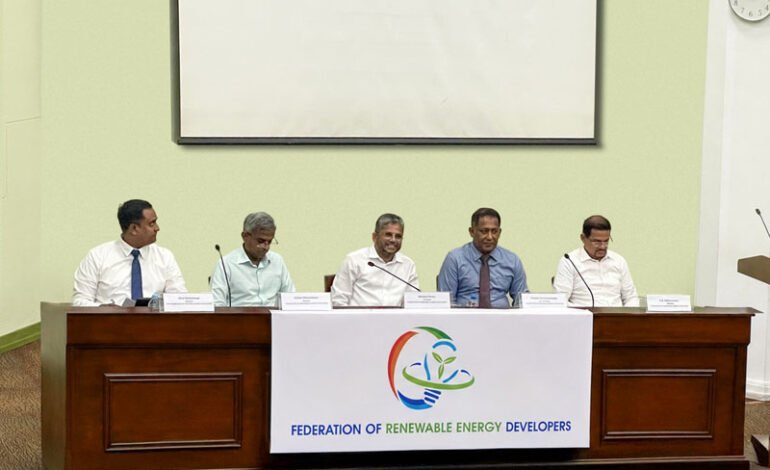
The concerns were raised at a press conference hosted by FRED at the Ground Floor Auditorium of The Ceylon Chamber of Commerce, bringing together renewable energy developers and key industry stakeholders to highlight the scale of the issue and its implications for energy security, investor confidence, employment, and the wider financial system.
According to FRED, the payment delays are affecting close to 400 small and medium-scale renewable energy developers and entrepreneurs operating across ground-mounted solar, mini-hydro, wind, biomass, and other renewable energy segments. The affected capacity exceeds 1,000 MW, covering 389 plants with a combined installed capacity of 1,073.9 MW.
FRED noted that renewable energy developers have continued to supply power to the national grid despite the suspension of payments, placing severe pressure on working capital, debt servicing, plant maintenance, and salaries. The Federation warned that continued non-payment could lead to rising non-performing loans in the banking sector, disruption to renewable energy operations, and a gradual reduction in available clean power capacity.
The Federation also raised concerns over the prioritisation of payments for thermal power generation at a time when renewable energy developers remain unpaid. It noted that the cost of thermal generation has increased sharply, while renewable energy producers, who provide comparatively lower-cost and cleaner power, are facing serious liquidity constraints.
FRED stated that this situation has broader implications beyond the renewable energy sector. If unresolved, the crisis could weaken investor confidence in future renewable energy tenders, increase the perceived risk of investing in state-linked energy projects, and undermine Sri Lanka’s long-term clean energy targets.
The Federation called on the Government of Sri Lanka, the Ministry of Finance, the General Treasury, and relevant authorities to take immediate steps to resolve the outstanding payments. It urged Treasury intervention, the allocation of funds specifically for renewable energy developer payments, and a Cabinet-level directive to expedite financial solutions before the sector faces widespread defaults.
FRED emphasised that timely payment for power already supplied is essential to maintain operational continuity across the renewable energy sector and to safeguard the livelihoods connected to it, including technical staff, engineers, electricians, mechanics, administrative employees, and other workers.
The Federation reaffirmed its willingness to work with the government and relevant institutions to support a stable and sustainable energy future for Sri Lanka. However, it stressed that immediate financial relief is necessary to prevent further deterioration of the sector and to protect the country’s renewable energy capacity.